Virtual Renders
Zero-Data Dependency
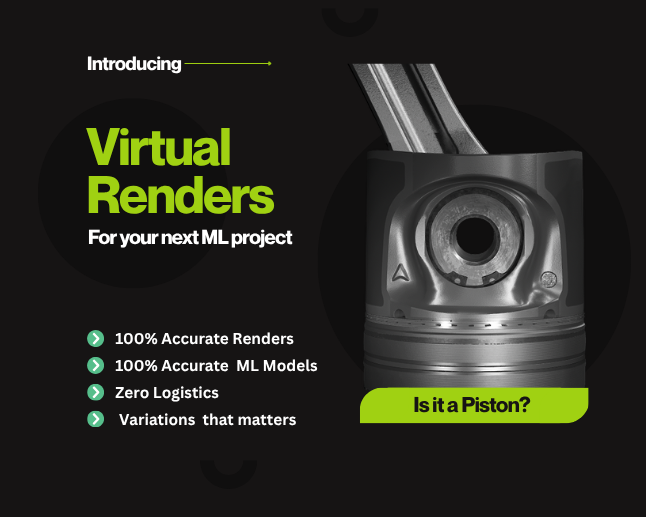
In the real-world situation, capturing thousands of images across all possible defects scenarios to train the machine learning models is time consuming, expensive, and infeasible. To overcome these issues, our Virtual Renders service addresses these challenges by creating photorealistic images that covers all possible defect scenario using the CAD models provided by the client.
In traditional data collection, client have to invest significant time and efforts to manually generate and capture defects scenarios. However, with our Virtual Rendering approach, defects condition can be generated quickly and at scale. This approach saves lot of time, efforts, and resources.
This service fills the data gap in industrial AI development that enabling faster deployment of vision-bases quality assurance system with zero real-world dependency.
Features:
1. Data synthesis using CAD – It will eliminate the need of physical samples. It generates high quality 3D-rendered images.
2. Defects Simulation – It applied wide range of synthetic defects like cracks, dents, corrosion, missing features, misalignment, surface anomalies etc. across multiple angles and lighting conditions
3. Unlimited dataset creation – Scale up image volumes with varied backgrounds, lighting, camera angles and defects severities.
4. Zero Logistic Cost – No need to transport the defects parts or halt production lines to generate the defects.
5. Fast iteration – Quickly generate new datasets to retrain models as part geometric or inspection requirements evolve.
6. Domain Randomization – Improve model generalization by exposing AI to diverse scenarios without real-world constraints.
Benefits:
1. Quick AI training – quickly start vision model development with complete, balanced, and labelled dataset.
2. Cost and Time savings – This service will save week / months of time in manual data collection.
3. Risk-Free data collection – This service will eliminate the handling of damaged or defective parts in physical world.
4. Customizable Output – Control every detail like camera spaces, resolution, defect types, lighting condition, background etc.
Applications:
1. AI Models for visual inspection
2. Anomaly detection
3. Part identification and classification
4. Pre-training of model before deploying on the production